Realising your child is being bullied can be very hard for a parent. It's also far more common than many people realise: in a national survey from 2022 to 2023, around a third of children aged 10 to 15 said they had experienced in-person bullying in the past year (ONS, 2024). And it's never the child's fault. Bullying can affect a young person's mental health, their schoolwork and their friendships, but there are real grounds for reassurance: a warm, supportive home is linked with children coping better, and with the right support, many children recover well. This guide looks at the forms bullying can take, the impact it can have, what schools are required to do, and how counselling can help.
Article summary
Key takeaways
- Being bullied is never the child's fault, and it isn't a sign of weakness in them.
- Bullying is common: in a 2022 to 2023 survey, around 1 in 3 children aged 10 to 15 said they had been bullied in person in the past year.
- The effects are real, but research suggests some of the harm runs through a child's distress, and that distress can be supported.
- Schools have a legal duty to prevent and tackle bullying, and every school has a complaints procedure you can use if yours is slow to act.
- Counselling can offer real support, and many children recover well with the right help.
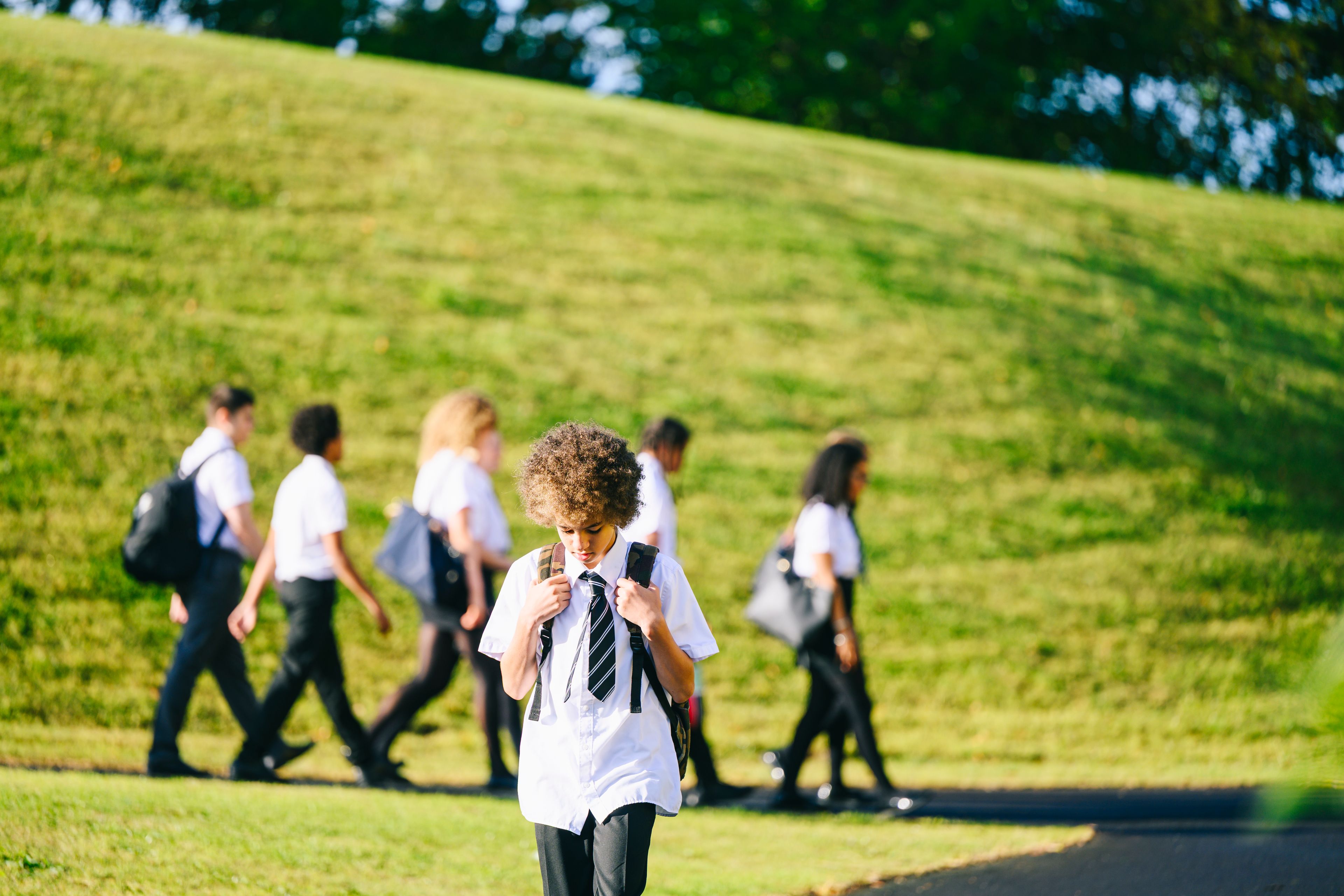
If your child is being bullied, or you suspect they might be, it’s stressful. There's the distress of knowing they're being hurt, the helplessness of not being there when it happens, and often a long, frustrating struggle to get the situation taken seriously. Some parents also worry that they should have noticed sooner. This guide is here to help you understand what's happening, what it's doing to your child, and what genuinely helps.
One thing to hold onto from the start: being bullied is never the bullied child's fault, and it isn't a sign of weakness in them. Bullying is something done to a child, and it can be addressed. One of the most helpful things a parent can do for them is show they’re taking it seriously.
If you are worried about your child's safety, contact your GP and ask for an urgent appointment, or call NHS 111. If you believe your child is in immediate danger, do not wait. Call 999 or go to A&E. Your child can talk to Childline free and in confidence on 0800 1111 if they're under 19, and you can reach the Samaritans on 116 123 or text SHOUT to 85258 at any hour. Finding Therapy isn't a crisis or emergency service.
What's bullying?
Not every unkindness or fall-out is bullying, and it helps to be clear about the difference, because schools, and sometimes parents, can disagree about whether a situation counts.
Bullying is behaviour that is repeated, intended to hurt someone physically or emotionally, and involves an imbalance of power.
Those three features together are what distinguish bullying from ordinary conflict:
- Repeated. It happens again and again, rather than as a single incident.
- Intentional. It's meant to hurt, frighten, humiliate, or exclude.
- A power imbalance. The child being bullied finds it hard to defend themselves or stop it, whether because of numbers, social status, age, size, or something else.
A one-off argument between two children of roughly equal standing, even a heated or hurtful one, is a fall-out, not bullying. It still matters and may need help, but it's a different thing. A harmful incident doesn't have to count as bullying to need action, though: a single assault or a serious threat still deserves a response. Holding onto that definition helps when you're advocating for your child, because it moves the conversation with school from "children will be children" to "this is a recognised, repeated pattern that needs a response" [2].
The different forms bullying takes
Bullying is far broader than the playground stereotype of physical aggression. It usually falls into a few overlapping types:
- Verbal. Name-calling, taunting, threats, and cruel jokes. This is the most commonly reported form of in-person bullying[3].
- Physical. Hitting, pushing, tripping, spitting, or damaging belongings.
- Social or relational. Deliberately excluding a child, spreading rumours, turning friends against them, or humiliating them in front of others. Because it leaves no marks, this quieter form is often missed, yet it can be just as damaging.
- Cyberbullying. Harassment through messages, social media, group chats and games, covered in its own section below.
Naming the form your child is experiencing helps, both for your own clarity and when you raise it with school.
Cyberbullying
Cyberbullying is bullying that follows a child through their phone and screen. One reason it can be so hard is that it can feel as if there's no safe place to escape: the harassment reaches into a child's bedroom, at any hour, and can be seen by a large audience. Most children who are bullied online are also bullied in person, though not all, and children targeted in both ways tend to fare worst of all [4].
It is common, though less common than in-person bullying. A national survey from 2022 to 2023 found that around 1 in 5 children aged 10 to 15 in England and Wales, roughly 847,000, had experienced online bullying in the past year, with girls more affected than boys [3].

The law has recently caught up with the harm. Under the Online Safety Act 2023, since July 2025 the online services children use, from social media to messaging apps and games, must protect children from a defined list of harmful content that explicitly includes bullying, enforce their age limits, and act on illegal material. The regulator, Ofcom, can fine companies that fail, by up to £18 million or a tenth of their global turnover [5]. It does not make cyberbullying vanish, but platforms must now give parents and children clear and accessible ways to report problems.
Practical steps can help. Save screenshots before anything can be deleted, make your own report on the platform as well as helping your child block or mute the account, and keep talking with your child rather than simply taking the device away, which can feel like a punishment for being a victim [6]. Tell the school if another pupil is involved. If you think a crime may have been committed, such as threats, sexual images or a hate crime, you can report it to the police on 101, and if your child is in immediate danger, call 999. The aim throughout is to keep the lines of communication open so your child keeps telling you.
How common is bullying?
Bullying is a common difficulty in childhood. If your child is being bullied, they aren't alone, this isn't rare, and it isn't a reflection of something unusual or wrong about them.
1 in 3
children aged 10 to 15 said they had experienced in-person bullying in the past year, in a national survey from 2022 to 2023
Around the world the picture is similar, with roughly one in four children experiencing bullying as a victim [7]. The point for parents is simple: this is a widespread problem, and one that schools have a clear responsibility to address.
Who gets bullied, and why it's never their fault
Any child can be bullied. It's worth saying clearly, because both parents and children often quietly search for a reason in the bullied child themselves. There's no quality in a child that makes bullying acceptable or deserved.
It's true that some groups of children are targeted more often. Children with special educational needs or a disability are bullied more often than their peers, and autistic children are among the most likely to be bullied [8] [1]. LGBT+ young people are bullied at roughly double the rate of their classmates [9]. Appearance is the single most common trigger that bullied children themselves point to [10]. But every one of these is a fact about the behaviour of those who bully, not a flaw in the children who are bullied. The response is never to ask a child to change who they are, or to hide it. It's to address the bullying.
43%
of LGBT+ pupils had been bullied in the past year, double the 21% rate among their non-LGBT+ classmates
This matters because many bullied children conclude that the bullying is their fault, or that there's something wrong with them. Hearing clearly and repeatedly from the adults around them that this isn't true can make a real difference to a bullied child.
Signs your child may be being bullied
Many children don't tell their parents they're being bullied. They may feel ashamed, fear it will make things worse, worry about disappointing you, or believe nothing can be done. So it often shows up in other ways:
- Reluctance or refusal to go to school, or wanting to be driven rather than walk or take the bus.
- Physical complaints, such as stomach aches and headaches, especially on school mornings.
- Becoming withdrawn, anxious, tearful or unusually irritable.
- Trouble sleeping, nightmares, or a change in appetite.
- Unexplained cuts, bruises, or lost and damaged belongings.
- A drop in grades, concentration or interest in things they used to enjoy.
- Asking for or stealing money, which can be a sign of a child being extorted.
These signs aren't a checklist. No single sign proves bullying, and a child can be bullied without showing obvious changes. If you notice a cluster of changes, especially around school, take it seriously and ask your child about it calmly.
The impact of bullying on mental health
Bullying isn't easy for a child to shrug off. It's consistently linked to anxiety, low mood, self-harm and, in the most serious cases, suicidal thoughts [7], and it can affect a child's self-esteem. The link with depression is strong: a large review found that bullied children were close to three times more likely to experience depression than children who weren't bullied [11].

There's also evidence that bullying may do more than sit alongside these difficulties. A large study of twins, designed to separate the effect of bullying from a child's pre-existing make-up, found results suggesting that being bullied can contribute to anxiety and depression in its own right [12]. One way it may do this is by leaving a child feeling that other people can't be trusted, a sense of distrust that is itself linked with later mental health problems [13]. This helps explain why rebuilding a child's trust and sense of safety is often a central part of recovery.
How bullying affects school, friendships and the future
Parents often worry less about how common bullying is and more about what it's doing to their child here and now, and further down the line. The answer from the research is that the effects are real and reach into several areas of life. Reassuringly, some of the harm seems to run through the distress bullying causes, which is something support can help ease.
School and grades
Bullying can make it harder to learn. Across large international studies, bullied children tend to have lower academic achievement [14]. A study in Ireland found that part of that link runs through the emotional and behavioural difficulties bullying can create, so addressing a child's distress may help them recover their footing at school [15].
Getting to school at all
For many children, one of the most visible effects is on attendance. The dread of facing the place where the bullying happens can show up as school refusal, or as headaches and stomach aches on school mornings, and in one US study, online bullying was linked with roughly double the likelihood of a child missing school out of fear [16]. If this is your situation, our guide to school anxiety and emotionally-based school avoidance goes into much more depth.
Friendships and trust
Bullying can leave a child wary of other people, slower to trust, and more likely to expect the worst of their peers. That guardedness is understandable, but left unaddressed it can outlast the bullying itself and make new friendships harder, which is one reason rebuilding trust is a focus of counselling.
The longer term
The effects of bullying can last a long time. Following a large group of British children born in 1958 into midlife, researchers found that those who had been frequently bullied still had raised rates of depression, anxiety and suicidal thoughts at the age of 45, decades after the bullying itself [17].

The reach can be practical as well as emotional. The same 1958 British cohort found that adults bullied as children were, on average, less likely to be in work at 50, and that bullied women earned less [18], and a UK study following young people to age 25 linked bullying to worse exam results, poorer mental health and lower income [19].
Two things make this less frightening than it first sounds. First, these are raised risks across large groups, not a fixed fate for any one child. Second, the risks are highest where bullying is frequent, which is one reason noticing it, believing your child, and getting support early matters. A study following children in the UK and the US linked being bullied by peers to worse long-term mental health than being mistreated by adults. It's a reminder that bullying is not a harmless part of growing up.
Being bullied by peers in childhood had generally worse long-term effects on young adults' mental health than being maltreated by adults.
A note on the child who bullies
It can help to know that children who bully are often struggling themselves, with their own difficulties at home, with friendships, or with managing strong feelings. This is an explanation, not an excuse, and it doesn't lessen your responsibility to protect your own child. But it can make the situation easier to think about clearly, and it's a reminder that schools addressing bullying well support every child involved, not only the target. Children who are both bullied and bully others, sometimes called bully-victims, can have a particularly hard time, with the highest risk of depression in a large review of studies[11], which is part of why a good school response looks at the whole picture rather than only handing out a punishment.
Bullying between siblings
Bullying does not only happen at school. Bullying between brothers and sisters is common and easy to dismiss as ordinary squabbling, but when it is repeated, one-sided and meant to hurt, it is bullying, and it has been linked with poorer mental health in its own right [21]. The same principles apply at home as at school: name it calmly, make clear it is not acceptable, protect the child being targeted, and resist treating it as two children who simply need to get along. If it involves violence, injury, threats or control, or your child is frightened to be at home, get help from outside the family: talk to your GP or your child's school, contact your local council's children's services if you think a child is at risk of harm, and call 999 if anyone is in immediate danger.
What it's like for parents
It's worth naming how hard this is for you, too. Parents of bullied children often carry anger, helplessness, guilt and exhaustion, and many lose sleep over it. You may also be managing a drawn-out and frustrating process with a school that's slow to act. Looking after yourself, leaning on other adults you trust, and pacing the fight are all part of being able to keep showing up for your child.
What to say and what not to say
When a child tells you they're being bullied, your first response matters. A few things help:
- Take it seriously, and say so. "I'm really glad you told me, and I'm going to take this seriously" is a good start. Let them tell it in their own way, without lots of questions.
- Make it clear it isn't their fault. Say it more than once, because they may not take it in the first time.
- Stay calm on the outside. Big adult anger, even on their behalf, can frighten a child into saying less.
- Ask what they want to happen. A child who fears you will "make it worse" needs to feel some control over the next step.
Try to avoid "just ignore it", "stand up to them", or anything that implies they brought it on themselves. These are common reflexes, but they can leave a child feeling more alone.
What you can do as a parent
Beyond talking with school, a supportive home is linked with how well children cope with bullying. In a UK study of twins, warmth at home was linked with bullied children coping better, and comparisons between identical twins suggested that the warmth itself, not something inherited, was making a difference [22].
Warm family relationships and a positive home environment help to buffer children from the negative outcomes associated with being bullied.
In practice that means keeping home a place where your child feels liked, listened to and safe, protecting the routines and relationships that steady them, and staying connected even when they're withdrawn. Alongside that, keep a calm record of incidents, raise it with school in writing and ask about their anti-bullying policy, and escalate if the response falls short. Warmth at home and persistence with school aren't alternatives; they go hand in hand.
What your child's school must do, and how to make them act
Schools are not just morally expected to deal with bullying; they are legally required to. By law, under the Education and Inspections Act 2006, every council-maintained school in England must have a behaviour policy that includes measures to prevent all forms of bullying among pupils, and it must be shared with pupils, staff and parents [2]. Academies and independent schools have an equivalent duty to put an effective anti-bullying strategy in place. You are entitled to ask for that policy and read it. The legal duties and the escalation route described here apply in England; Scotland, Wales and Northern Ireland have their own arrangements, though the principle that schools must act is the same.
By law, all state (not private) schools must have a behaviour policy in place that includes measures to prevent all forms of bullying among pupils.
There can be a second layer of protection. If your child is being targeted because of their disability, race, religion, sex, sexual orientation or gender reassignment, the Equality Act 2010 may also apply. For advice about discrimination, GOV.UK points parents to the Equality Advisory and Support Service, and the government's anti-bullying guidance explains what the law means for schools [2]. If bullying raises a safeguarding concern, for example if you think your child may be at risk of serious harm, raise it with the school's designated safeguarding lead, the member of staff responsible for keeping children safe, or with your local council's children's services.
In practice, the things that can help move a school to respond are often unglamorous. Keep a dated written record of every incident: what happened, when, who was involved and what you reported. Raise it with the class teacher or head of year, and put it in writing so there is a clear trail. Ask what the anti-bullying policy says will happen, and by when.
If the response falls short, follow the school's complaints procedure. Every school in England must have one, and it's usually on the school's website or available from the school office. If you've been through the whole procedure and are still unhappy, GOV.UK's guide to complaining about a school explains where you can go next. For a state school, that can include the Department for Education, or Ofsted, which looks at problems affecting the whole school rather than individual cases. Persistence, calmly documented, often helps.
What actually reduces bullying
It's worth knowing what the evidence says works, because it shapes what to ask your school for. Anti-bullying programmes in schools do reduce bullying, by roughly 15 to 20% across a large body of trials [24]. They work best when the school owns the problem rather than handing it to the children to sort out among themselves; peer schemes can sometimes make things worse, according to an earlier review of these programmes[25].
There is an important limit, though. Those same programmes have only a very small effect on pupils' anxiety and low mood [26]. Preventing bullying across a school and helping one hurt child recover are two different jobs, which is one reason individual support for your child sits alongside, not inside, whatever the school is doing.
One finding is worth holding onto. In one Canadian playground study, when another child stepped in, bullying usually stopped quickly, within ten seconds more than half the time. The trouble is that, in the same study, other children were present for most bullying but stepped in only about one time in five [27]. Helping children understand that telling an adult, or quietly supporting a targeted friend, is the opposite of weakness is part of how the culture around a child shifts.
When to seek professional help
It's worth seeking professional support if the bullying has led to ongoing anxiety, low mood, sleep problems, school refusal, or a clear drop in your child's confidence that isn't lifting, even if the bullying itself has stopped. If you are worried about your child's safety at any point, contact your GP urgently or call NHS 111, and if you believe your child is in immediate danger, call 999 or go to A&E. A good first step is to speak to your GP or a trusted member of school staff, and to consider specialist counselling for your child.
How counselling helps
Counselling can give a bullied child a safe, usually private space with a trained adult whose only job is to help them. There, a child can talk about what happened, including feelings they may hide from you to protect you, begin to untangle the self-blame, and slowly rebuild their sense of worth and their trust in other people. A UK evaluation of school-based counselling found it was linked with improvement for pupils who had been bullied [28].
Research hasn't yet established a single therapy specifically for children who have been bullied [29]. At Finding Therapy, counsellors get to know your child and draw on whichever approach fits them. For one child that might be person-centred work that can rebuild confidence through a trusting relationship; for another, cognitive behavioural techniques to loosen anxious or self-critical thinking [30]; for a younger child, creative and play-based work; and where a proper assessment shows that bullying has left significant trauma symptoms, a trauma-focused approach. In one small study of adults who had been bullied at school, most said person-centred counselling had helped them [31]. Whatever the approach, the relationship matters: across therapies, the bond between a young person and their counsellor is consistently associated with better outcomes [32]. Counselling doesn't replace your GP or urgent help if you're worried about your child's safety.
A clinical perspective from one of our counsellors
Helen Spiers, MBACP (Accred), Head of Counselling at Finding Therapy, shares how she works in her sessions:
"I was a teacher for fifteen years before I retrained as a counsellor, and I’ve also worked as a school counsellor too. Between them, those years taught me how much a child can already be carrying by the time an adult thinks to ask, and how hard it is for a parent who’s trying to get something done about it."
"A child who has been bullied often arrives braced for more questions about it, so in the early sessions we talk about almost anything else. They need to find out that I’m safe before they’ll risk telling me what actually happened, and that can take a few weeks rather than a few minutes. When it does come, it usually arrives in something small, a detail about a lunchtime or a group chat. I’m not in a hurry, because being allowed to go slowly is often what reassures them that counselling is safe."
"Much of the work after that is about giving a child back some say. Being bullied is a long stretch of things being done to you with no control over any of it, so in our sessions they decide what we talk about and what we leave alone. If they want to spend a session on something else entirely, that is a good use of the time rather than avoidance. I don’t ask a child to tell the whole story again for my benefit. Most of them have told it several times already, to adults who couldn’t make it stop, and being asked to repeat it can feel like one more thing to get through."
"When I was a school counsellor it was very clear that children found it hard to open up in the place where the bullying was happening. Sometimes a child would come to me from a lesson with the people involved, say very little, and walk straight back out into the same corridor. In my experience, working online has often been easier for them. They’re somewhere they feel safe and there’s no one to run into afterwards."
"What I would want a parent to know is that many children do come back from this, in their own time. The signs things are getting back to normal are rarely dramatic. It usually shows up as a child who argues with their sibling again, or mentions someone from school without flinching, or asks to go somewhere at the weekend. Those signs tend to arrive before a child is able to say out loud that they feel better."
Why online therapy can suit this work
Online counselling widens the pool, so a child can be matched to a counsellor with the right experience for their needs rather than whoever happens to be local. For anxiety and depression in children and young people, research suggests therapy delivered through a screen can work about as well as meeting in person [33], and for many young people the familiarity of a screen can make it easier to open up. That research was not about bullying specifically, so treat it as general reassurance about online therapy for young people rather than proof for this. Online counselling isn't right for every situation: where there is a significant risk to safety, a safeguarding concern, or a need for more intensive or specialist assessment, other support may be better.
Recovery: what it actually looks like
Many children do recover well from bullying. It rarely looks like a single moment when everything is fine again. More often it's a gradual return of confidence, of trust in friends, and of interest in the things a child set aside. Some children start to feel better once the bullying is properly addressed and they feel believed and safe; others need longer to rebuild. Encouragingly, a UK twin study found that some of bullying's effects on mental health can ease over time [12]. Progress isn't always steady, and there can be harder patches along the way, but with support things often ease.
A final word
If your child is being bullied, two things are worth holding onto: it isn't their fault, and it can be addressed. Bullying is a widespread and serious problem, but it's one that schools have a legal duty to act on and that many children recover from.
At Finding Therapy, we have counsellors experienced in supporting children and young people through bullying and its effects, whether the bullying is ongoing or its impact has outlasted it. You can look through our counselling directory and find someone who you think would be a good fit, or if you’re not sure, book a free consultation and you’ll speak to our Head of Counselling. There’s currently no waiting list, and a first session is usually possible within 48 hours. If you're worried about your child's safety right now, don't wait for counselling to start: contact your GP or NHS 111, raise any safeguarding concern with the school or your local council, and call 999 if your child is in immediate danger.
Frequently asked questions
References
- The Anti-Bullying Alliance (n.d.). Information and resources on bullying, including definitions, types of bullying, and advice for families, Anti-Bullying Alliance. https://anti-bullyingalliance.org.uk/ ↩
- Department for Education (2017). Preventing and tackling bullying: advice for headteachers, staff and governing bodies., Department for Education. https://www.gov.uk/government/publications/preventing-and-tackling-bullying Accessed 16 June 2026. ↩
- Office for National Statistics (2024). Bullying and online experiences among children in England and Wales: year ending March 2023., Office for National Statistics. https://www.ons.gov.uk/peoplepopulationandcommunity/crimeandjustice/bulletins/bullyingandonlineexperiencesamongchildreninenglandandwales/yearendingmarch2023 Accessed 16 June 2026. ↩
- Li et al. (2022). Traditional bullying and cyberbullying in the digital age and its associated mental health problems in children and adolescents: a meta-analysis., European Child and Adolescent Psychiatry. https://doi.org/10.1007/s00787-022-02128-x Accessed 16 June 2026. ↩
- GOV.UK (2025). Online Safety Act: explainer and collection., GOV.UK. https://www.gov.uk/government/collections/online-safety-act Accessed 16 June 2026. ↩
- Internet Matters (2024). Cyberbullying: advice and support for parents., Internet Matters. https://www.internetmatters.org/ Accessed 16 June 2026. ↩
- Ariani et al. (2025). Global prevalence and psychological impact of bullying among children and adolescents: a meta-analysis., Journal of Affective Disorders. https://doi.org/10.1016/j.jad.2025.119446 Accessed 16 June 2026. ↩
- Humphrey and Hebron (2015). Bullying of children and adolescents with autism spectrum conditions: a ‘state of the field’ review, International Journal of Inclusive Education, 19(8), 845-862. https://doi.org/10.1080/13603116.2014.981602 Accessed 13 October 2026. ↩
- Just Like Us (2021). Growing up LGBT+: the impact of school, home and coronavirus on LGBT+ young people, Just Like Us. https://justlikeus.org/research-report-growing-up-lgbt-bullying/ Accessed 13 October 2026. ↩
- Ditch the Label (2020). The annual bullying survey., Ditch the Label. https://www.ditchthelabel.org/research-report Accessed 16 June 2026. ↩
- Ye et al. (2023). Meta-analysis of the relationship between bullying and depressive symptoms in children and adolescents., BMC Psychiatry. https://doi.org/10.1186/s12888-023-04681-4 Accessed 16 June 2026. ↩
- Singham et al. (2017). Concurrent and longitudinal contribution of exposure to bullying in childhood to mental health., JAMA Psychiatry. https://doi.org/10.1001/jamapsychiatry.2017.2678 Accessed 16 June 2026. ↩
- Tsomokos et al. (2024). Bullying fosters interpersonal distrust and degrades adolescent mental health., Nature Mental Health. https://doi.org/10.1038/s44220-024-00203-7 Accessed 16 June 2026. ↩
- Samara et al. (2021). How can bullying victimisation lead to lower academic achievement?, International Journal of Environmental Research and Public Health. https://doi.org/10.3390/ijerph18052209 Accessed 16 June 2026. ↩
- Murphy et al. (2022). Educational achievement and bullying: the mediating role of psychological difficulties., British Journal of Educational Psychology. https://doi.org/10.1111/bjep.12511 Accessed 16 June 2026. ↩
- Grinshteyn and Yang (2017). Electronic bullying and school absenteeism., Journal of School Health. https://doi.org/10.1111/josh.12476 Accessed 16 June 2026. ↩
- Takizawa et al. (2014). Adult health outcomes of childhood bullying victimization: evidence from a five-decade longitudinal British birth cohort., American Journal of Psychiatry. https://doi.org/10.1176/appi.ajp.2014.13101401 Accessed 16 June 2026. ↩
- Brimblecombe et al. (2018). The long term economic impact of childhood bullying victimisation., Social Science and Medicine. https://doi.org/10.1016/j.socscimed.2018.05.014 Accessed 16 June 2026. ↩
- Gorman et al. (2021). Adolescent School Bullying Victimization and Later Life Outcomes., Oxford Bulletin of Economics and Statistics. https://doi.org/10.1111/obes.12432 Accessed 16 June 2026. ↩
- Lereya et al. (2015). Adult mental health consequences of peer bullying and maltreatment in childhood: two cohorts in two countries, The Lancet Psychiatry. https://doi.org/10.1016/S2215-0366%2815%2900165-0 ↩
- Wolke et al. (2015). Bullying in the family: sibling bullying., Lancet Psychiatry. https://doi.org/10.1016/S2215-0366(15)00262-X Accessed 16 June 2026. ↩
- Bowes et al. (2010). Families promote emotional and behavioural resilience to bullying: evidence of an environmental effect., Journal of Child Psychology and Psychiatry. https://doi.org/10.1111/j.1469-7610.2010.02216.x Accessed 16 June 2026. ↩
- Department for Education (2017). Bullying at school: the law, GOV.UK. https://www.gov.uk/bullying-at-school/the-law ↩
- Gaffney et al. (2021). Effectiveness of school-based programs to reduce bullying perpetration and victimization: an updated systematic review and meta-analysis., Campbell Systematic Reviews. https://doi.org/10.1002/cl2.1143 Accessed 16 June 2026. ↩
- Farrington and Ttofi (2009). School-Based Programs to Reduce Bullying and Victimization, Campbell Systematic Reviews: Better Evidence for a Better World. https://doi.org/10.4073/csr.2009.6 Accessed 13 October 2026. ↩
- Guzman-Holst et al. (2022). Research Review: Do antibullying interventions reduce internalizing symptoms? A systematic review, meta-analysis, and meta-regression exploring intervention components, moderators, and mechanisms, Journal of Child Psychology and Psychiatry. https://doi.org/10.1111/jcpp.13620 Accessed 16 June 2026. ↩
- Hawkins et al. (2001). Naturalistic observations of peer interventions in bullying., Social Development. https://onlinelibrary.wiley.com/doi/10.1111/1467-9507.00178 Accessed 16 June 2026. ↩
- McElearney et al. (2013). Impact evaluation of a school-based counselling intervention for bullied pupils., Child Care in Practice. https://doi.org/10.1080/13575279.2012.732557 Accessed 16 June 2026. ↩
- Lydecker (2022). Trauma-focused cognitive behavioural therapy for victims of bullying., Journal of Prevention and Health Promotion. https://doi.org/10.1177/26320770221074008 Accessed 16 June 2026. ↩
- Stallard (2021). Evidence-based practice in cognitive behavioural therapy., Archives of Disease in Childhood. https://doi.org/10.1136/archdischild-2020-321249 Accessed 16 June 2026. ↩
- Jones (2020). Is person‐centred counselling effective when assisting young people who have experienced bullying in schools?, Counselling and Psychotherapy Research. https://doi.org/10.1002/capr.12312 Accessed 16 June 2026. ↩
- Roest, J., Welmers-van de Poll, M., Van der Helm, G. H. P., Stams, G. J. J. M., & Hoeve, M. (2022). A three-level meta-analysis on the alliance-outcome association in child and adolescent psychotherapy, Research on Child and Adolescent Psychopathology. https://link.springer.com/article/10.1007/s10802-022-00986-2 Accessed 16 June 2026. ↩
- Bevilacqua et al. (2024). Effectiveness of technology-assisted vs face-to-face cognitive behavioural therapy for anxiety and depression in children and young people., Clinical Child Psychology and Psychiatry. https://doi.org/10.1177/13591045241259070 Accessed 19 August 2026. ↩


