
Most children settle into secondary school, but it often takes longer than parents expect. For some children it can be especially difficult, and they may need extra support to navigate the transition. This guide sets out what is normal in the first weeks of Year 7, how to tell ordinary settling in from something that needs more help, and what makes a difference at home.
Article summary
Key takeaways
- Most children settle into secondary school. In one large UK study, around three quarters had a positive or moderately positive experience of the move.
- Worries usually ease across the first term. Half term is a useful point to take stock, but if you’re worried before then, that’s reason enough to ask for help.
- What children worry about is social, not academic. Friendships and bullying come well ahead of lessons and homework.
- Signs worth a closer look: distress that seems to be settling in rather than passing, daily battles at the school gate, or symptoms spilling into weekends.
- Backing your child’s growing independence is linked to settling in better. Belonging matters too, and one club or one trusted adult can help build it.
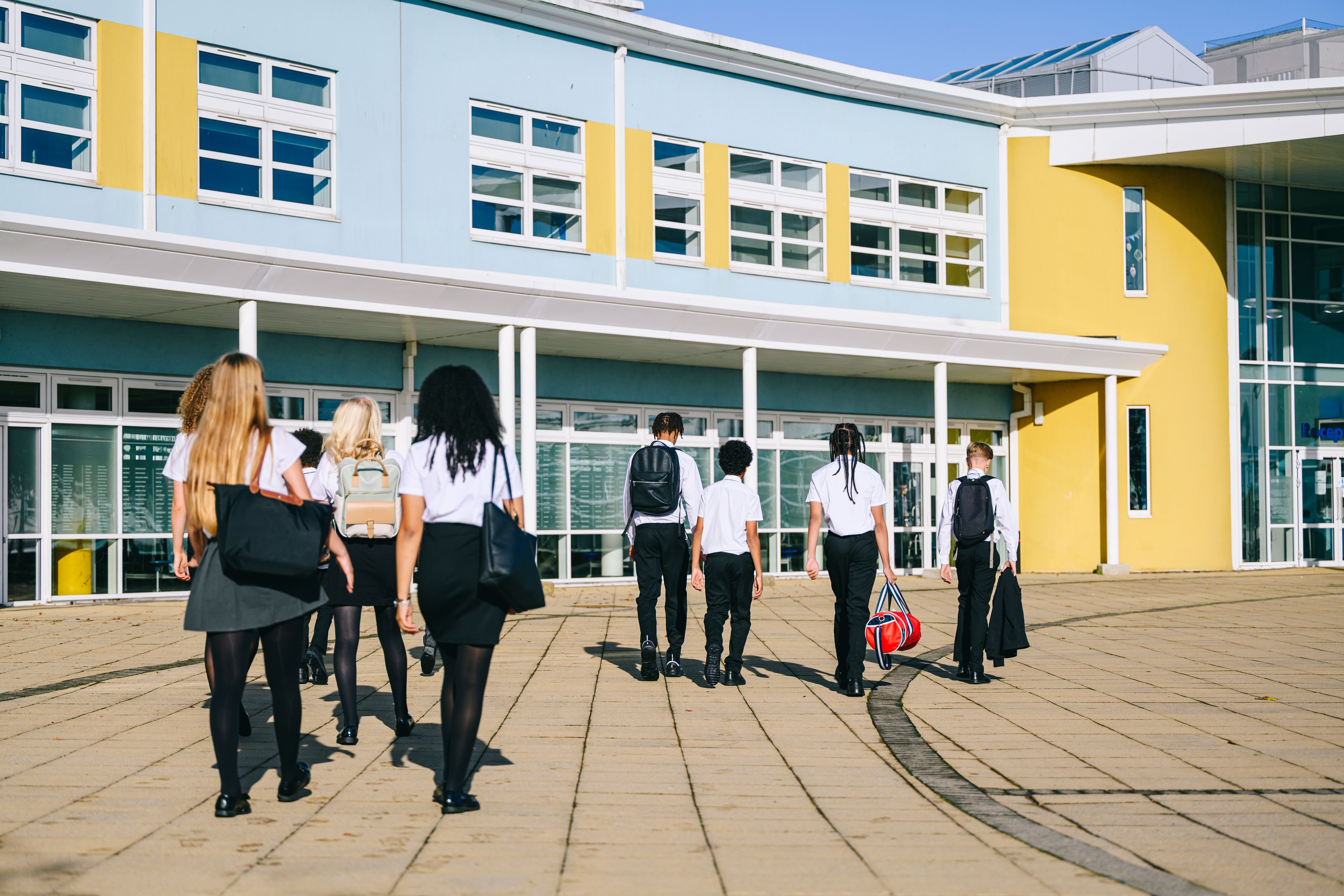
If your child started secondary school a few weeks ago and it isn't going well, you're probably starting to worry. Maybe they come home flat and head straight for their room. Maybe the tears arrive on Sunday evening. Or maybe you get nothing at all, just "fine", and you can't tell what that really means.
Most children do settle. It often takes longer than parents expect, and the first few weeks are not a reliable guide to how the rest of the year will go. A small number struggle in a way that needs more than time, and the signs are recognisable once you know what to look for. This guide sets out what's normal, what's worth a closer look, and what actually helps.
Most children do settle
It’s often said that starting secondary school is one of the most stressful events in a child’s life. Recent UK evidence doesn’t support that view.
A large Scottish study backs this up. It followed children from late primary school into their first year of secondary, and most had a positive or mostly positive experience of the move [1]. The authors argue that this contradicts much of the earlier research, which used smaller groups and asked children to remember the move long afterwards.

Children’s worries about secondary school also tend to fall once they’re actually there [2]. And when researchers have tracked anxiety across the move, rather than assuming it rises, they’ve found that on average it doesn’t. In one study following children for seven years, most stayed roughly where they were, a small group became more anxious, and a slightly larger group became less anxious [3].
So the evidence doesn’t show that starting secondary school makes children anxious. For a small number of children, the move can shift things in either direction.
What’s normal in the first few weeks
Quite a lot, as it turns out.
The child who is tired by Thursday and exhausted by Friday is normal. So is the one who holds it together all day and falls apart the moment they walk through your door. That can be a sign they feel safe with you, rather than that something terrible happened at school. So is the one who has stopped talking, loses at least one water bottle a week, gets on the wrong bus, and cannot explain any of it.
The scale of the change is genuinely large. They’ve gone from one classroom and one teacher who knew them well to a building several times the size, ten or more subject teachers, a timetable that changes daily, a new journey, and a new set of classmates, often without the friends they had at primary.
1 in 3
Children aged 10 and 11 who said they were quite or very worried about moving to secondary school
Worry is only half the picture. The large survey of children in Wales behind that figure also found that around two thirds were looking forward to the move. The two feelings were only loosely related [4]. Plenty of children were worried and excited at the same time. If your child seems to be both dreading school and telling you about a new friend, they are not being inconsistent. That’s normal.
Timing matters too. When researchers asked children after the move how it had felt, they said they had worried very little while still at primary school. The anxiety built over the summer holidays and carried on into the start of Year 7 [5]. If you’re reading this in September, you’re quite possibly reading at the peak rather than at the end.
What they’re actually worried about, and it’s not lessons
Parents tend to worry about the work. Children almost never do.
Across the research, the biggest worries are social. In the Welsh survey, the main worries were bullying and what would happen to existing friendships, well ahead of anything academic [4]. Another study, based on workshops with children, found the same. Their fears were about being picked on by other children, being alone, and being told off or humiliated by adults. Only one kind of fear was about failing at the work [6].
Major sources of worry about transition centred around bullying and impact on existing friendships, while forming new friendships or joining existing friends in their new school were key things children looked forward to.
This matters practically. "How were your lessons?" is a question almost designed to get you nothing. "Who did you sit with at lunch?" will tell you far more, because lunch and the corridor are where the real difficulty lives.
Worry before the move is also linked to one thing in particular: loneliness. In a UK study that followed children through the move, those who worried more beforehand were more likely to feel lonely by the end of Year 7 [7].
So is it just taking time to settle in, or is it something more?
Worries about secondary school normally ease across the first term [2]. So the useful question is not "is my child upset?" in week two, when a great many children are. It’s whether the difficulty seems to be settling in rather than passing. Half term is a natural point to take stock. That’s a rough guide drawn from group averages, not a test for one child, and if you’re worried before then, that is reason enough to ask for help.
Then look at the shape of it rather than the intensity of any single day. These are the signs that warrant a closer look:
- It seems to be settling in rather than passing, or it’s getting worse.
- The distress has spread beyond the school gate into evenings, weekends and holidays.
- Mornings have become a daily battle rather than an occasional bad one.
- Physical symptoms most school mornings, typically stomach aches or headaches, that disappear at weekends.
- They’re pulling away from friends they still have, rather than struggling to make new ones.
- Sleep has gone, or they’re sleeping far more than usual.
- The way they talk about themselves has changed.
These are prompts rather than a checklist, and each of them can have other causes. If you’re worried, that is reason enough to ask for help.
There’s a good reason to take a first-term pattern seriously rather than waiting it out. Children who were worried about the move beforehand were more likely to still be finding it hard at the end of Year 7 [8], and in one UK study a difficult start was still linked to lower mood a few years on [9]. Those are averages across thousands of children, not a forecast for yours, and the effects are modest. But they point the same way: a difficult start is far easier to turn around in the first term than once it has become the norm.
"Should I force them to go?"
Avoidance works brilliantly in the short term. Staying home reduces the anxiety today, and the relief is real. One way of understanding what happens next is that staying away can feel like proof that school was dangerous, and that avoiding it kept them safe. So tomorrow can feel harder than today. Research also links anxiety with both school refusal and unauthorised absence [10].
If this is where you are, you’re far from alone. In the autumn term of 2025, just over one in five secondary pupils in England were persistently absent, meaning they missed a tenth or more of school [11], and attendance has still not recovered to where it was before the pandemic.
So the answer is neither dragging them through the door nor accepting that they will not go. It’s small, graded steps back, agreed in advance with the school, with a named person for your child to go to and somewhere to go when it gets too much. A late start or a partial day is not a failure. It’s a way back in.
Getting a child back through the door and easing their distress are two different jobs. A review of school refusal treatments found that therapy improved attendance without necessarily reducing the anxiety underneath [12]. Both need attention. Our guide to emotionally based school avoidance goes into this in much more depth.
What actually helps at home
Children tend to settle better when parents back their growing independence rather than tighten control. In one study, children whose parents were the most controlling found it hardest to adjust after moving up [13]. Another, across three separate school moves, found that support for a child’s independence from either parent was linked to less low mood [14]. In practice that means being interested rather than inspecting, and letting them solve what they can solve.
Belonging matters a great deal, and it can be built. Feeling connected to school is linked to less low mood and anxiety across the move, and the link runs both ways [15]. Children who felt they belonged in their last year of primary tended to have better mental health a year later, whether or not they had additional needs [16]. It doesn’t take a transformation. One club, one after-school activity, or one adult in the building who knows their name is often enough.
The other thing worth building is your child’s confidence that they can handle feeling bad. Children who believed in Year 6 that they could manage difficult feelings were getting on better socially four months into secondary school [17]. So helping a child believe they can cope with the feeling may do more than removing the thing they’re afraid of.
The children I meet in the first term of Year 7 often cannot tell you what is wrong, and being asked directly tends to make it harder. Working online helps more than people expect. They are in their own room, with their own things, and they can look away from the screen whenever they need to, which is far less demanding than sitting opposite an adult who is waiting for them to speak. When it does come, it rarely arrives as an explanation. It arrives as a small detail about lunchtime.
If your child is autistic, has ADHD, or has additional needs
For autistic children, how the move goes may have more to do with the schools than with the child. A study in England followed autistic children through the move. Things about the child measured beforehand, such as verbal ability, autistic traits, sensory differences or anxiety, were not linked to how it went four months later. How it went was linked instead to school and system factors, such as disagreements over school choice and poor communication between the two schools [18].
How well the move went seemed to be linked mostly to the schools and the wider system. The main factors were tensions over school choice, delays in placement decisions, too little preparation at primary school, and poor communication between the two schools.
In other words, the useful question is not what is wrong with your child. It’s what the school is actually doing, and what you can ask them to do differently.
The picture is also less alarming than it’s often painted. A UK study of autistic children in mainstream schools found their difficulties didn’t get markedly worse, and parents reported less bullying. But existing difficulties carried over, and were sometimes under-recognised [19]. Another study, which also included children with Down syndrome or Williams syndrome, found parents reported little change in anxiety across the move, though what drove it changed [20]. The risk is less that the move breaks something, and more that what was already there stops being seen.
One warning you can act on: the standard support for the move may not suit children with additional needs. A UK study found that school-level transition strategies (such as a bridging project started in Year 6 and finished in Year 7) were linked to lower school anxiety in children without additional needs. In children with special educational needs, they were linked to higher school anxiety [21]. It’s reasonable, and evidence based, to ask for something individual instead. Our pages on autism and ADHD have more.
Parent nerves
Very little is written about this. But if you search for help with your child starting secondary school, many of the results are parents saying that they’re the ones who are frightened.
The research bears this out. When researchers spoke to children, parents and teachers about the move, all three groups described going through something similar emotionally. All three talked about managing their own feelings as well as everyone else’s [22]. Another study found that parents who are more worried about the move tend to have children who are more worried too [23].
That second finding is easily misread. It shows the two worries go together, but it cannot tell us which way the influence runs. It’s at least as likely that parents of children who are struggling have more to worry about.
What it does suggest is that children read the adults around them, and that looking after your own nerves is part of the job rather than a distraction from it. Some advice aimed at parents says to feel the worry but try not to let it show. Hiding it and handling it are different things, and a child who watches a parent notice their own nerves and carry on anyway is learning something useful.
When to get more help, and what counselling can and cannot do
If the pattern above looks familiar, the first conversation is usually with the school rather than the GP. At secondary level it helps to know who you’re asking for: the form tutor for day to day things, the head of year for anything that needs authority behind it, and the special educational needs and disability coordinator, usually called the SENDCO, if there are additional needs. Ask for something specific, such as a named adult, a safe place at break, or a phased return, rather than raising a general concern. Our guide to talking to school about your child's mental health sets out how to prepare for that conversation.
If things are not shifting, or if you’re worried about your child's mood rather than just their school attendance, the next step is your GP. We have separate guides on when to speak to the GP and on what to expect from CAMHS, including the waiting times.
On counselling, two things are true. Therapy for anxiety in young people helps more than no treatment. In a review of the trials, more than a third no longer had their main anxiety disorder afterwards, compared with fewer than one in ten of those not treated [24]. That’s a real difference, but it’s also not a guarantee.
The second is that nobody has tested counselling specifically as support for a school move. The evidence supports therapy helping anxious young people. It doesn’t yet tell us it smooths the move to secondary school. What does seem to matter is the fit: one-to-one work has tended to help more than group work for this age group [25]. A trusting relationship between a young person and their counsellor is also consistently associated with better outcomes.
For many families the school and the GP are the right first call. If you’d also like your child to have someone of their own to talk to, you can browse our counsellors at Finding Therapy and choose someone yourself. We’ve vetted every one of them, and we’ve known them for years. If you’d like help choosing, you can book a free consultation with Helen Spiers, our Head of Counselling. We’re a private, paid service, so there’s no GP referral needed, and we work with children and young people aged 6 to 25.
Frequently asked questions
References
- Jindal-Snape et al. (2023). Primary-secondary school transition experiences and factors associated with differences in these experiences: Analysis of the longitudinal Growing Up in Scotland dataset., Review of Education. https://doi.org/10.1002/rev3.3444 Accessed 11 August 2026. ↩
- Rice et al. (2011). Assessing pupil concerns about transition to secondary school., British Journal of Educational Psychology. https://doi.org/10.1348/000709910x519333 Accessed 11 August 2026. ↩
- Nelemans et al. (2017). Individual differences in anxiety trajectories from Grades 2 to 8: Impact of the middle school transition., Development and Psychopathology. https://doi.org/10.1017/s0954579417001584 Accessed 11 August 2026. ↩
- Child Indicators Research (2021). Children aged 10 and 11 who said they were quite or very worried about moving to secondary school. https://doi.org/10.1007/s12187-021-09815-2 ↩
- Curson et al. (2019). Exploring the experience of students making the transition from primary school to secondary school., Psychology Teaching Review. https://doi.org/10.53841/bpsptr.2019.25.1.30 Accessed 11 August 2026. ↩
- Stiehl et al. (2023). Children's perspective on fears connected to school transition and intended coping strategies., Social Psychology of Education. https://doi.org/10.1007/s11218-023-09759-1 Accessed 11 August 2026. ↩
- Rice et al. (2021). Pupil Mental Health, Concerns and Expectations About Secondary School as Predictors of Adjustment Across the Transition to Secondary School., School Mental Health. https://doi.org/10.1007/s12310-021-09415-z Accessed 11 August 2026. ↩
- Donaldson et al. (2024). Trajectories of mental health across the primary to secondary school transition., JCPP Advances. https://doi.org/10.1002/jcv2.12244 Accessed 11 August 2026. ↩
- West et al. (2010). Transition matters: pupils' experiences of the primary-secondary school transition in the West of Scotland and consequences for well-being and attainment., Research Papers in Education. https://doi.org/10.1080/02671520802308677 Accessed 11 August 2026. ↩
- Finning et al. (2019). The association between anxiety and poor attendance at school: a systematic review., Child and Adolescent Mental Health. https://doi.org/10.1111/camh.12322 Accessed 11 August 2026. ↩
- Department for Education (2026). Pupil absence in schools in England: autumn term 2025/26, Department for Education. https://explore-education-statistics.service.gov.uk/find-statistics/pupil-absence-in-schools-in-england/2025-26-autumn-term Accessed 7 October 2026. ↩
- Maynard et al. (2015). Psychosocial Interventions for School Refusal with Primary and Secondary School Students., Campbell Systematic Reviews. https://doi.org/10.4073/csr.2015.12 Accessed 11 August 2026. ↩
- Bouffard et al. (2022). Profiles of Parenting Autonomy Support and Control: A Person-Centered Approach in Students' Adjustment to the Transition to Middle School., Journal of Early Adolescence. https://doi.org/10.1177/02724316221136039 Accessed 11 August 2026. ↩
- Duineveld et al. (2017). The Link Between Perceived Maternal and Paternal Autonomy Support and Adolescent Well-Being Across Three Major Educational Transitions., Developmental Psychology. https://doi.org/10.1037/dev0000364 Accessed 11 August 2026. ↩
- Lester et al. (2013). The Relationship Between School Connectedness and Mental Health During the Transition to Secondary School., Journal of Psychologists and Counsellors in Schools. https://doi.org/10.1017/jgc.2013.20 Accessed 11 August 2026. ↩
- Vaz et al. (2014). School Belongingness and Mental Health Functioning across the Primary-Secondary Transition in a Mainstream Sample., PLOS ONE. https://doi.org/10.1371/journal.pone.0099576 Accessed 11 August 2026. ↩
- Nowland et al. (2020). Influence of social anxiety and emotional self-efficacy on pre-transition concerns, social threat sensitivity, and social adaptation to secondary school., British Journal of Educational Psychology. https://doi.org/10.1111/bjep.12276 Accessed 11 August 2026. ↩
- Makin et al. (2017). The primary-to-secondary school transition for children on the autism spectrum: A multi-informant mixed-methods study., Autism and Developmental Language Impairments. https://doi.org/10.1177/2396941516684834 Accessed 11 August 2026. ↩
- Mandy et al. (2016). The transition from primary to secondary school in mainstream education for children with autism spectrum disorder., Autism. https://doi.org/10.1177/1362361314562616 Accessed 11 August 2026. ↩
- Sideropoulos et al. (2024). Anxiety during transition from primary to secondary schools in neurodivergent children., JCPP Advances. https://doi.org/10.1002/jcv2.12262 Accessed 11 August 2026. ↩
- Neal et al. (2016). Exploring the longitudinal association between interventions to support the transition to secondary school and child anxiety., Journal of Adolescence. https://doi.org/10.1016/j.adolescence.2016.04.003 Accessed 11 August 2026. ↩
- Bagnall et al. (2020). 'You're in this world now': Students', teachers', and parents' experiences of school transition and how they feel it can be improved., British Journal of Educational Psychology. https://doi.org/10.1111/bjep.12273 Accessed 11 August 2026. ↩
- Măirean et al. (2022). Children's anxiety, academic self-efficacy, and intergenerational transmission of worries regarding the transition to middle school., British Journal of Educational Psychology. https://doi.org/10.1111/bjep.12530 Accessed 11 August 2026. ↩
- Baker et al. (2021). The Effectiveness of Psychological Therapies for Anxiety Disorders in Adolescents: A Meta-Analysis., Clinical Child and Family Psychology Review. https://doi.org/10.1007/s10567-021-00364-2 Accessed 11 August 2026. ↩
- Reynolds et al. (2012). Effects of psychotherapy for anxiety in children and adolescents: a meta-analytic review., Clinical Psychology Review. https://doi.org/10.1016/j.cpr.2012.01.005 Accessed 11 August 2026. ↩